




Small-Batch Vial Label Printing: Solving Lab R&D Challenges with the iDPRT iT4S Thermal Transfer Printer
Precise identification of peptide vials, research compounds, and laboratory samples is essential for reliable traceability. In pharmaceutical R&D and small-batch production, label data often changes from batch to batch, making pre-printed labels less flexible and more costly for short runs.
To ensure sample integrity, laboratories need an agile, in-house labeling system. The iDPRT iT4S desktop thermal transfer label printer provides exactly that. With high-resolution printing, extreme environmental durability, and professional software integration, it helps production teams build a flexible labeling workflow for high-value samples.
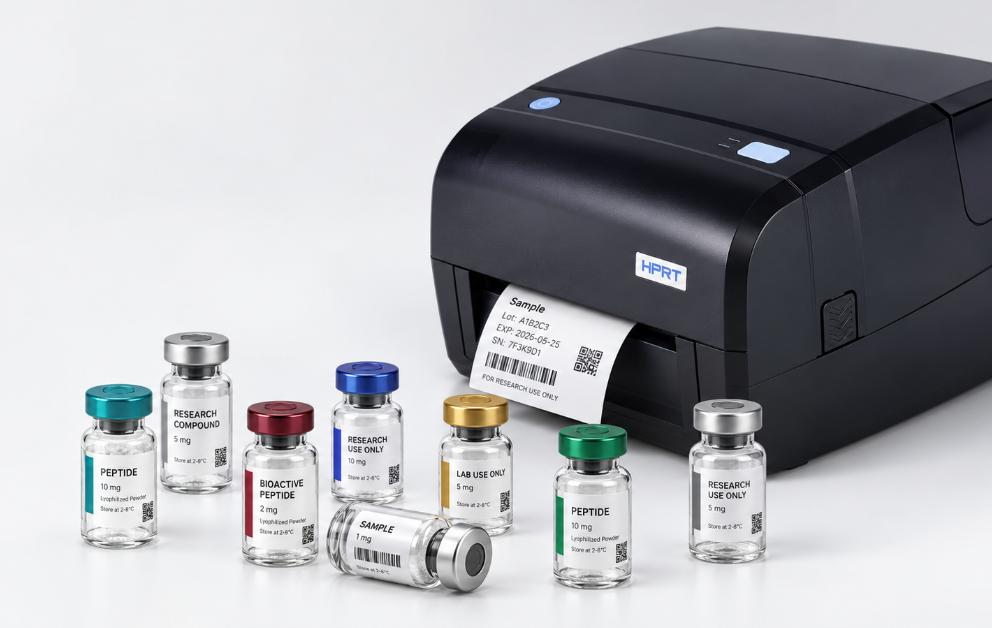
Quick Summary: Small-Batch Vial Labeling with the iT4S
- The Challenge: Micro-vials (1.5 mL–3 mL) require tiny, high-density 2D barcodes that must survive liquid nitrogen (-196°C) and harsh solvents like DMSO.
- The Technology: Direct thermal labels will fade and fail. Laboratories must use Thermal Transfer printing with full resin ribbons on synthetic cryogenic media.
- The Solution: The iDPRT iT4S is a 300 dpi desktop thermal transfer printer perfect for small-batch lab operations. It prints razor-sharp 4 pt micro-text and dense 2D barcodes, backed by native BarTender and LIMS integration for dynamic variable data.
Vial Label Printing Challenges in Research and Laboratory Workflows
In pharmaceutical and biotechnology environments, micro-vials (including 1.5 mL and 2 mL cryogenic vials, 3 mL peptide vials, and standard serum vials) often hold high-value research materials and samples.
However, the labeling challenges for these containers are often underestimated:
- ● High Information Density in Micro-Spaces: A standard label for a 1.5mL cryovial (e.g., 22mm x 22mm or a wrap-around style) must contain a Sample ID, lot number, concentration, date, and operator ID. Often, it must also include a 2D barcode for scanning.
- ● Frequently Changing Label Data: R&D, peptide research, and small-batch production mean information changes with every experimental batch or development stage. Outsourcing is slow and imposes high minimum order quantities, making it economically unviable and prone to waste due to data changes.
- ● Demanding Environmental Resistance: Samples are frequently stored in -80°C ultra-low temperature freezers or exposed to harsh solvents like DMSO and methanol. Standard direct thermal labels turn black or detach upon exposure to moisture or chemicals, leading to sample loss.
Therefore, laboratories need a comprehensive vial label solution capable of printing small fonts, crisp barcodes, and resisting extreme conditions while managing small-batch flexibility.
How the iDPRT iT4S Supports Small-Batch Vial Labeling
Backed by iDPRT’s expertise in professional AIDC and identification solutions, the compact iT4S benchtop printer fits seamlessly onto space-constrained lab counters, crowded R&D workstations, and QC prep benches.
By combining high-definition thermal transfer technology, versatile media compatibility, large-capacity ribbon loading, and advanced barcode rendering, the iT4S vial label printer optimizes efficiency across research, quality control, and short-run production workflows—bringing on-demand labeling for peptide, cryogenic, and general vials right to where samples are handled.
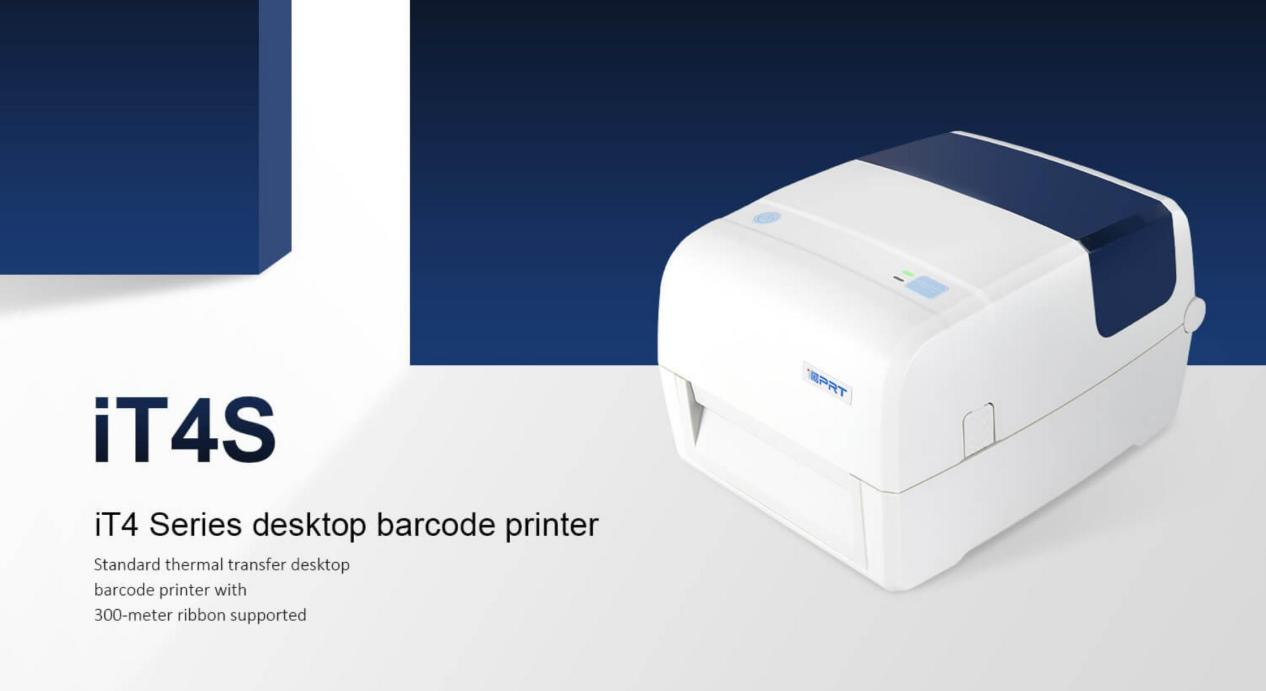
1. 300 DPI Resolution for Micro-Text & High-Density Barcodes
Standard 203 dpi barcode printers often struggle with 1.5 mL or 3 mL vials, producing blurred edges on small fonts and dense barcodes that hinder visual checks and scanning.
The iDPRT iT4S is available with a 300 dpi printhead, delivering exceptional clarity for micro-text down to 4 pt and high-density Code 128 or Data Matrix codes. This ensures effortless operator legibility and flawless barcode scanning in downstream workflows.
2. Thermal Transfer Durability for Extreme Lab Environments
The iT4S thermal transfer printer delivers resilient labeling designed to withstand moisture, freezing, abrasion, and solvents through matched ribbon-and-label solutions:
- ● Maximum Durability (Cryogenic Storage): Pairing a Full Resin Ribbon with a synthetic label stock (such as polypropylene (PP) or polyester (PET)) creates an identification system resistant to abrasion, harsh solvents, and cryogenic temperatures down to -196°C in liquid nitrogen. This is the standard for preserving high-value compounds and antibodies.
- ● Standard Durability (Routine & Short-Term Storage): Wax/Resin ribbons offer a balance of cost and scanning durability for samples stored at room temperature, under refrigeration (2°C to 8°C), or in standard -20°C freezers—ideal for peptides, enzymes, and routine working solutions.
3. Higher-Capacity Supplies and Optional Accessories for Better Efficiency
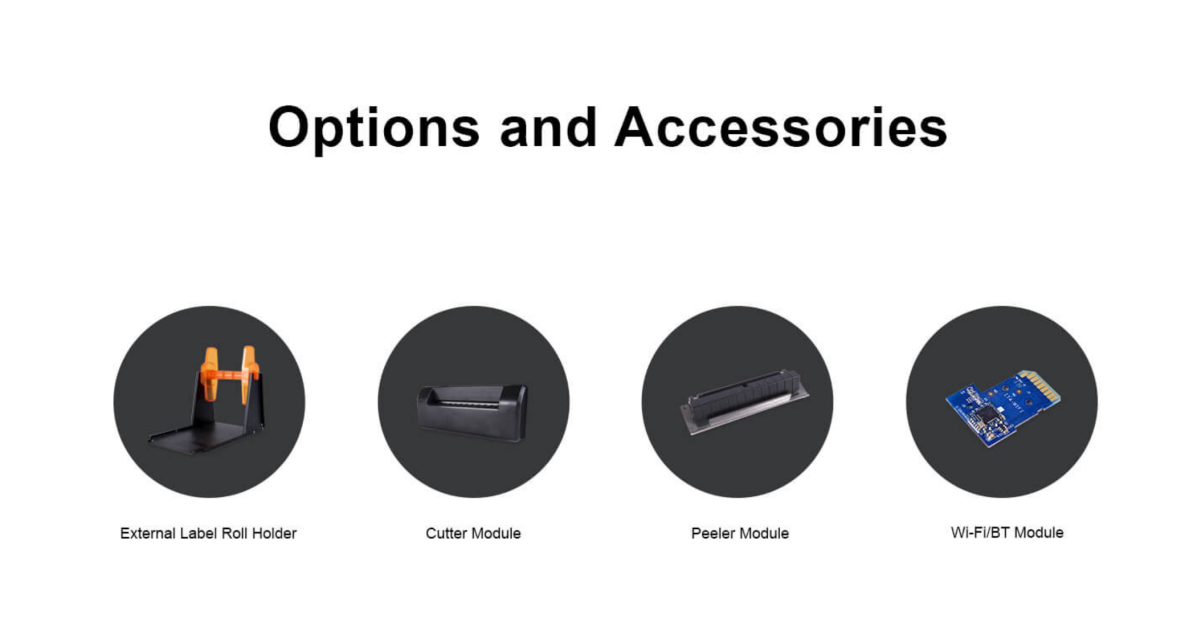
With support for 300-meter ribbon rolls, the iT4S outperforms cartridge-fed portable label makers in routine, small-batch vial labeling. Fewer ribbon changes reduce interruptions, while optional peeler and cutter modules help streamline label handling and application.
4. Seamless LIMS & BarTender Integration for Dynamic Data
Equipped with standard USB Type-B, Ethernet, and optional Wi-Fi/Bluetooth, the iT4S lab label maker integrates seamlessly into single-user or shared laboratory setups.
Powered by industry-standard BarTender software, it streamlines the handling of variable data (sample IDs, lot numbers, timestamps) for all text and barcode formats, while enabling seamless database and LIMS integration for regulated operations.
Common Lab Vial Labeling Applications for the iT4S
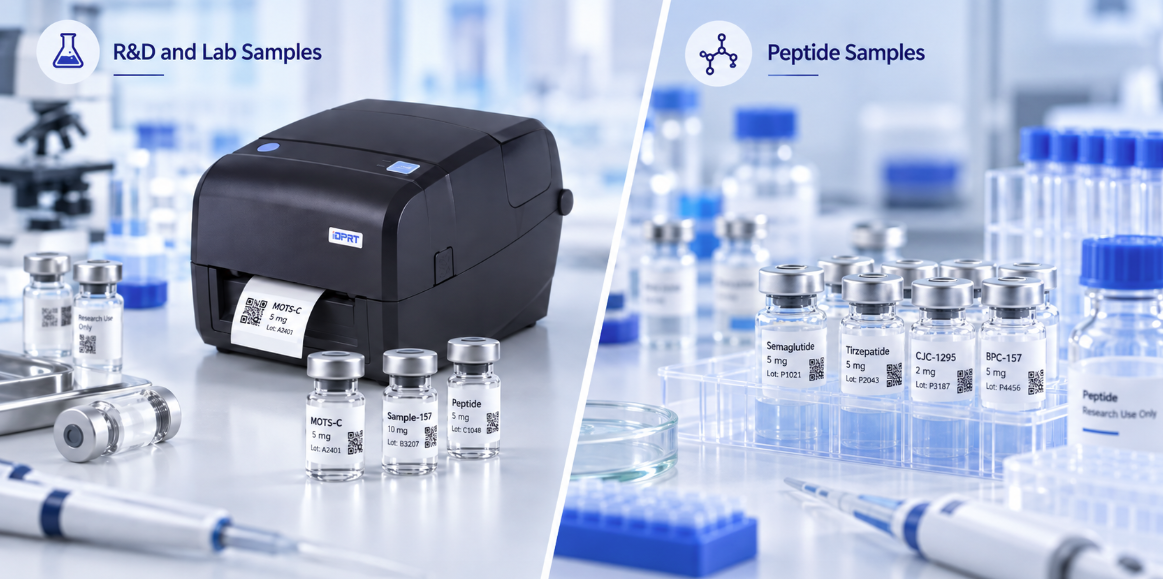
| Application Scenario | Typical Label Content | iT4S Advantage |
|---|---|---|
| R&D and Lab Samples | Sample Name, ID, Concentration, Date, Operator | Crisp micro-text and high-resolution Data Matrix codes for microscopic legibility. |
| QC and Retain Samples | Lot Number, Production Date, Test Code, Stability Status | Efficient batch serialization coupled with cryogenic durability (down to -196°C). |
| Reference Standards & Reagents | Reagent Name, CAS Number, Expiration Date, Identification Codes | 300 dpi resolution supports detailed text and compact machine-readable codes. |
| Multi-SKU Test Kits & Small-Batch Products (Including Peptides) | Product SKU, Lot Number, Expiration Date | High-mix, low-volume flexibility that significantly reduces outsourcing costs. |
| 3 mL and Micro-Vial Management | Unique Sample QR Code, Abbreviated Sample ID | Precision printing with optional peel-and-present mode for fast, one-handed vial labeling. |
Technical Specifications: iDPRT iT4S
| Specification | iDPRT iT4S |
|---|---|
| Printing Method | Thermal Transfer |
| Resolution | 203 dpi / 300 dpi |
| Max. Print Speed | 5 ips (203 dpi) / 4 ips (300 dpi) |
| Max. Print Width | 108 mm (203 dpi) / 106 mm (300 dpi) |
| Media Width | 25.4 mm–118 mm |
| Media Thickness | 60 μm–250 μm |
| Ribbon Types | Wax, Wax/Resin, Resin |
| Ribbon Width | 30 mm–110 mm |
| Max. Ribbon Length | 300 m |
| 1D Barcodes | CODE128, CODE39, CODE93, EAN, UPC, GS1 DataBar and more |
| 2D Codes | QR Code, Data Matrix, PDF417, Maxicode, Aztec and more |
| Standard Interfaces | USB Type-B, Ethernet |
| Optional Connectivity | Wi-Fi, Bluetooth |
| Label Design Software | Professional label design software included |
| Optional Accessories | External Peeler, Guillotine Cutter, External Label Roll Holder |
| Dimensions | 293 × 237 × 180 mm |
| Weight | 2.8 kg |
Ready to Transform Your Laboratory Labeling Workflow?
Don't let sub-standard labeling compromise your critical research or delay product release. Partner with iDPRT to configure a reliable, end-to-end small-batch vial labeling solution tailored to your laboratory's exact requirements.
Talk to an iDPRT Solution SpecialistFrequently Asked Questions (FAQs)
Q1: Why is thermal transfer preferred over direct thermal for vial labeling in laboratories?
Direct thermal labels fade or darken under UV, heat, moisture, alcohols, and solvents—unsuitable for long‑term tracking. Thermal transfer with resin ribbons on synthetic cryogenic media (e.g., polyester/polyimide) creates a fused, chemical‑resistant image that stays legible at −196°C, through freeze–thaw cycles, and during routine solvent/bleach exposure.
Q2: Can the iDPRT iT4S print readable barcodes on 1.5 mL or 2 mL micro-vials?
Yes. With its 300 dpi printhead option, the iDPRT iT4S cleanly prints micro-text down to 4 pt and crisp high-density 2D barcodes (such as Data Matrix or QR codes) designed to fit narrow wrap-around or cap labels for 1.5 mL and 2 mL vials.
Q3: Is the iDPRT iT4S compatible with Laboratory Information Management Systems (LIMS)?
Yes. Powered by industry-standard BarTender software and offering Ethernet, USB, and optional Wi-Fi/Bluetooth connectivity, the iT4S easily integrates with LIMS and custom laboratory databases to fetch dynamic sample IDs, lot numbers, and timestamps.